Serving El Monte, CA and surrounding areas.(626) 774-7973
Rio Hondo El Monte Concrete

Concrete Patio Construction on El Monte, CA Back Yard Fill

Rio Hondo El Monte Concrete pours rear-yard slabs on ground opened and probed first, holds the concrete off the house wall and saws the joints before dark. Every estimate is measured and written on site.

Google reviewsFacebook reviewsBetter Business Bureau reviews5.0 Stars How our customers score us · Facebook, Google and the BBB
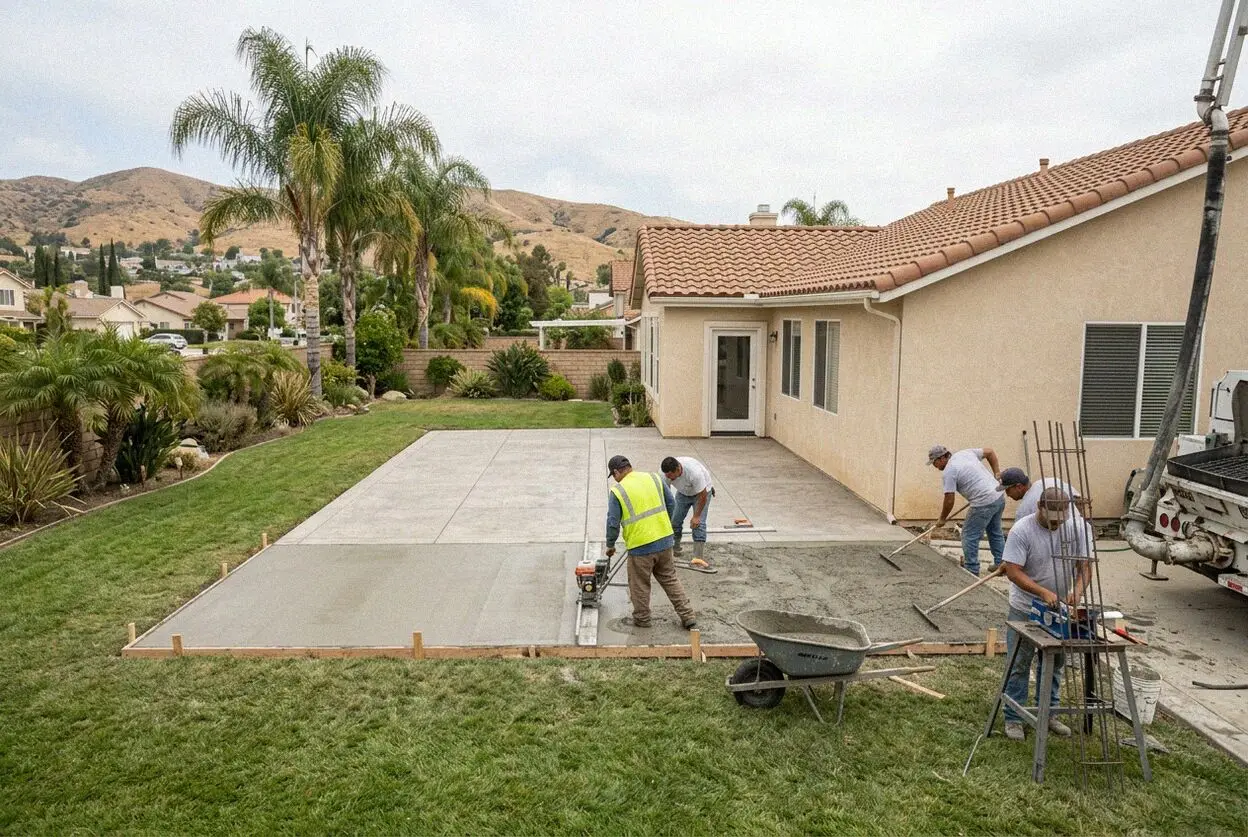
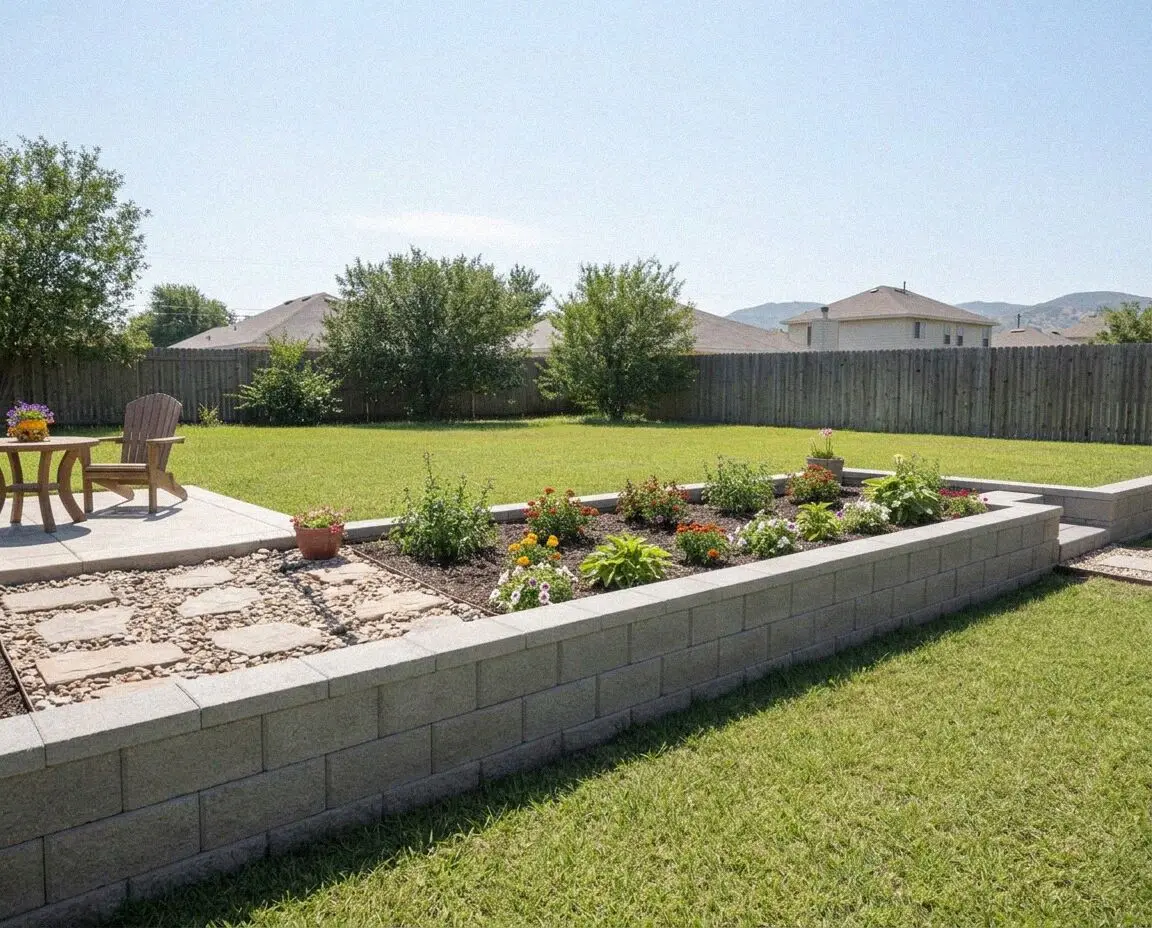
A new broom-finished patio slab behind an El Monte house
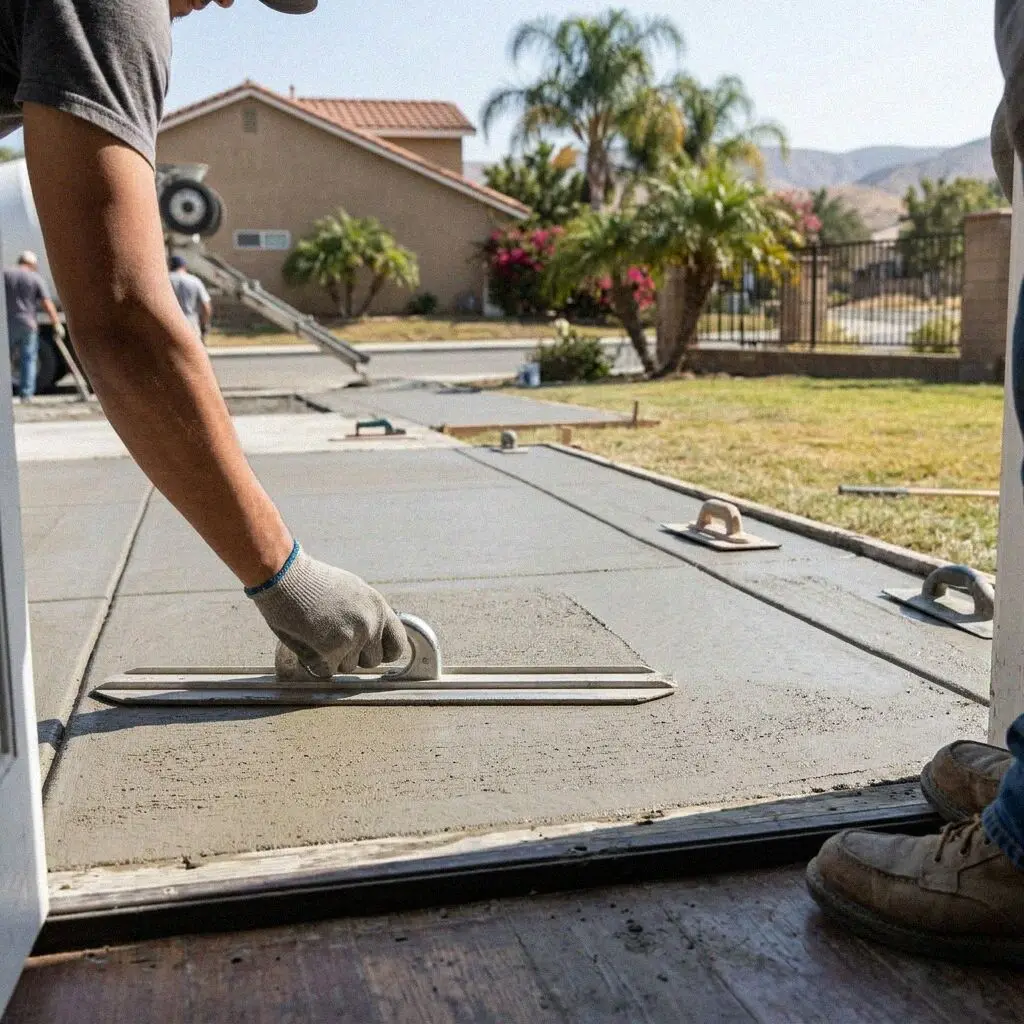
Crew placing a fresh patio slab in an El Monte back yard

The ground out the back

What an El Monte Back Yard Is Really Made Of

Of everything poured on a lot the patio carries the least, and a yard hides its faults for it. Nothing parks there, so soft ground gives no warning until the concrete parts over it. And the back half of a lot here is where things were built and later taken away, a detached garage reached down the side, a shed, a lean-to on the fence, each leaving a hole filled with what was lying about. We open the pad in three or four places before a figure is written, and it leaves with the old slab.

The forms out the back are set by Ismael Duarte, who has owned Rio Hondo El Monte Concrete since 2015 and gave the 21 years before it to other people's concrete in the San Gabriel Valley. This city fits 116,109 people into 9.65 square miles, so a rear yard is measured in feet off the fence rather than in yards, and one slab usually has to be the dining space, the route to the side gate and the standing for a bin store at once. Getting that shape settled on paper is most of the job here.

Concrete goes down on a CSLB C-8 classification held with the California Contractors State License Board, and liability insurance on every job is in force from the first cut. The state residential code exempts a driveway or a walk and names no patio slab, and no local list here adds one, so a patio is put to Building & Safety at City Hall West rather than assumed either way. Every yard leaves with a written workmanship guarantee against defects in how it was built.


Past the point of patching

Signs an El Monte Patio Slab Has to Come Out

A dip in the middle of it

Water standing in the center of a patio after rain, rather than along an edge, means the ground under the middle has gone down. On this valley floor that is nearly always fill dropped into an old post hole or a knocked-down outbuilding, and it carries on going down.

A crack that follows nothing

Shrinkage collects in the saw cuts. A crack that ignores the grid, runs straight across a groove and carries on to the far side is the slab breaking over something soft underneath. Sealing the line puts the top back together and leaves the void that opened it.

The slab has closed on the wall

A patio poured hard against stucco with no gap left gives rain a route down to the footing and buries the weep screed at the base of the wall. Once that edge has silted up and the paint above it is blistering, the concrete is what has to move, not the render.

The old slab is barely two inches

A great many back patios on these streets were laid by the household rather than by a crew, straight onto raked sand at whatever depth the mix ran to. Two inches will carry a chair and very little else, and no overlay puts back an inch that was never poured.

On every back-yard pour

What Is Carried on Every El Monte Patio

Eight things in the figure from the start, none of them offered later as an upgrade. Each answers what a back yard on this grid does to a slab: made ground beneath it, a house wall along one edge, and a neighbor's fence three feet off the other.

Old slab and fill out

The existing patio and any soft material beneath it leave the site together, before base is ordered.

The ground opened first

Test holes across the pad find the made ground before a depth, a base quantity or a figure is set.

Class 2 base, plate-rolled

Base in two layers with the plate over each, so the slab beds on something compacted, not raked sand.

Four inches of concrete

A 4-inch pour of 3,500 psi ready-mix, and 5 wherever a spa or a work bench will stand.

A break at the wall

A compressible strip runs the whole depth of the concrete where it meets stucco, and around each post.

Fall built into the slab

A quarter inch to the foot, taking water off the house and away from any fence rather than at it.

Joints in that afternoon

Cuts go in the afternoon of the pour at 8 to 10 feet, and closer wherever a test hole came up soft.

Footings for a cover

Where a cover is wanted, post footings are dug and poured under the slab rather than bolted on later.

What goes over it

What Else the Back Slab Has to Carry

The same 4-inch slab, four different jobs asked of it. What separates them is not the concrete but what has to be decided before the dig: a permit, a footing under a post, or a second surface that has to line up with the first.

OptionPoured atPermitDays in the yardAdding it later
Patio slab only4 inches over rolled baseAsked at the counter before we digTwo days, then seven curingAnything over it means bolts drilled in
Slab with cover footings4 inches, a footing under each postThe cover is its own building permitTwo days, plus the footing digThe cover can arrive years afterward
Patio and a rear-unit path4 inches across both, poured togetherGoes in with the rear unit's own plansThree days for the pairA path added later never lines up
New slab beside the oldMatched to the depth already thereSame question at the same counterOne day where nothing comes outThe two grays never quite close up

Footings and a connecting path can only go in while the forms are down. Everything else here waits a year; those two do not, and that is what the measure is for.

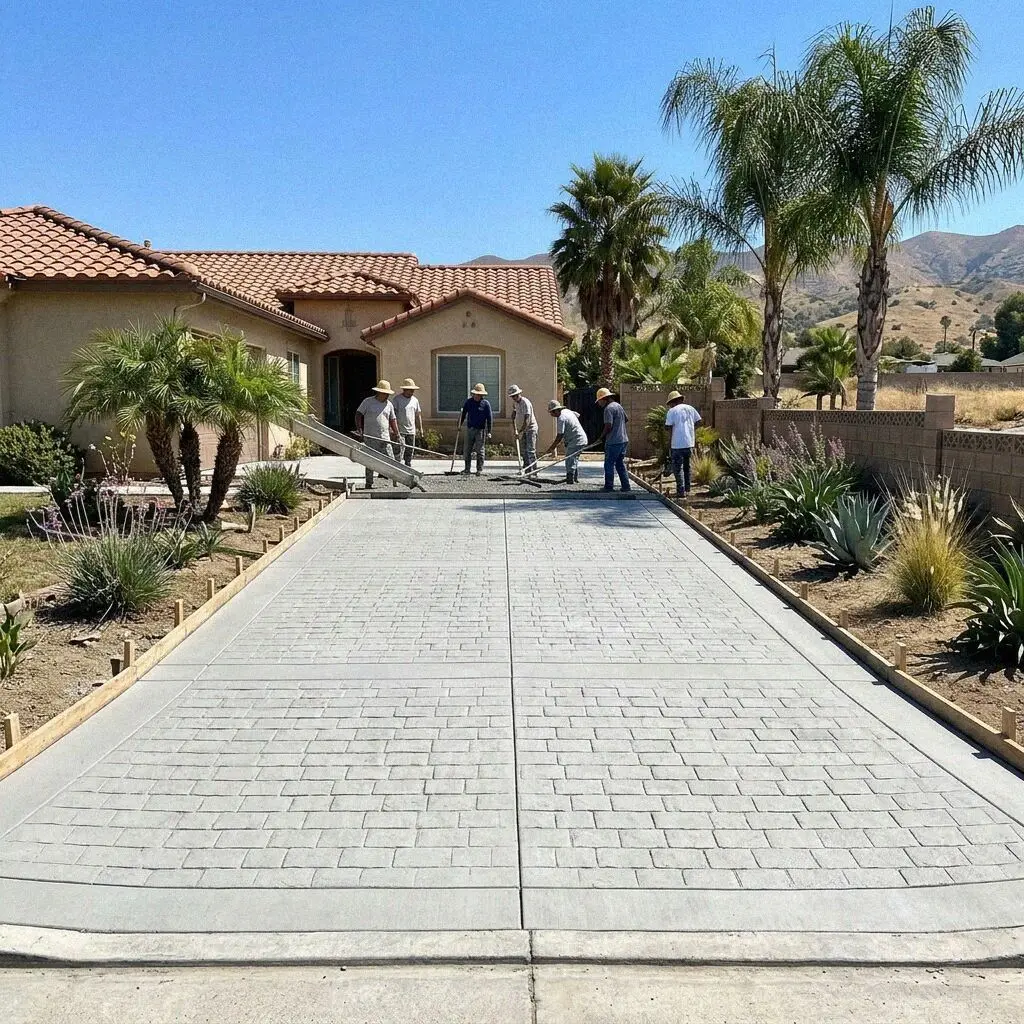
New patio concrete screeded between forms in an El Monte yard

Yard by yard

Why El Monte Back Yards Fail Where They Do

The native floor of this valley barely moves. What fails a drive at the front is a service trench; what fails a slab out the back is a hole somebody filled in.

Before the tracts arrived, a house on this grid kept its garage at the back of the lot and reached it down the side. Most have gone, and so have the sheds and lean-tos beside them, but the holes they left are still under the lawn, packed with broken slab, brick and whatever else was on site the day it came down. Sand of the kind this valley is made of takes compaction and stays put; a hole stuffed with rubble does neither, and it settles for decades. That is the ground a patio sits on.

The second thing a back yard settles is where water is meant to go. At the front it runs to the gutter and that is the end of it. Behind it there is no gutter, the fence is often a few feet off where the slab stops, and free-draining ground helps only where open soil is left for water to reach. So the fall is formed away from the house and turned down the side yard, never at a boundary, and where a rear unit has taken the open ground a channel across the slab runs it out to the front.

Call to walk-round

From First Measure to Cured Patio Slab

Five stages, one crew, and one figure written in the yard it applies to. The counter question and any cover permit are settled before a pour date goes in the book, so no week is held against paperwork nobody has filed yet.

1

Free measure in the yard

Ismael Duarte measures the space, digs test holes across the pad and writes the figure there and then.

2

Shape, finish and the counter

You settle size, edge and finish; we put the permit question to Building & Safety before a week is booked.

3

Break out and dig back

The old slab goes, fill under it is dug out to firm sand, and any cover footings are opened at the same time.

4

Base, forms, then concrete

Base rolled in lifts, forms set to the fall, then 4 inches placed and broomed once the sheen has gone off.

5

Grooves, cure, walk-round

Grooves in the same afternoon, the slab kept damp seven days, then a walk round it against your estimate.

Before you sign

What an El Monte Patio Figure Turns On

Area opens the figure and the dig closes it. Two identical rectangles on one street can end a day apart once the test holes are down, because one yard had an outbuilding standing on it and the other never did.

How much fill has to come out

Nobody knows until the pad is open, and it comes out and gets base behind it rather than packed back down.

What stands on the finished slab

A spa, a shed or a work bench takes 5 inches under it, and that is settled at the measure rather than later.

Whether a cover is in the plan

Post footings poured with the slab cost hours. Bolted on afterward they cost the panel they sit in.

What has to be worked around

A mature tree, a meter box or a rear unit already standing means hand digging and forms cut to fit them.

Coming out and putting a figure on paper is free, and an answer to your message comes within 1 business day. Nothing here is worked out off a plan or a photograph. (626) 774-7973 or send us a message.

Book a look at the yard out back

Leave the form or ring the number. You hear back within 1 business day, Ismael comes out to the yard itself, digs where he has to and puts the figure on paper before he leaves. It is yours either way.

Request a Free Estimate

Written on site · No obligation

By submitting, you agree to our disclosure and consent terms, including being contacted by Rio Hondo El Monte Concrete.

Back yards, in their words

Three Back Yards Repoured in El Monte

Three patios finished in the past two years on three El Monte streets, one over a filled-in garage pad, one poured with cover footings already in it, and one squeezed in beside a new rear unit.

Google review

“Our back slab had a dip in the middle that held water every winter. They dug test holes first and found the old garage pad broken up and buried under it. All of that came out, base went in, and 360 square feet went down at four inches. Two winters on and it is still flat.”

Rosa V. off Tyler AvePatio slab replacement · Google · 2026
Facebook review

“We wanted a cover eventually, so they put the footings in while the forms were still down. 420 square feet, grooves sawn the same afternoon, and the posts went up two summers later straight onto what was already there. Nothing has been drilled into the slab at all.”

Bao N. near Cypress AvePatio and cover footings · Facebook · 2025
BBB review

“The rear unit took most of our yard, so what was left had to work hard. Ismael set the fall away from both buildings and out to the side rather than at the fence, and the path ties into the patio on the same grooves. 280 square feet and it drains dry within the hour.”

Ernesto P. of El MontePatio beside a rear unit · BBB · 2026

Patio questions

Eight Things Asked Before a Patio Is Booked

Cost, the permit question, covers, what is under the yard, the wall, the water and how soon the table can go back out, the things households here settle before a date is booked.

(626) 774-7973
  • How is a back yard patio priced in El Monte?

    Area sets it and the dig moves it. A 350 square foot slab in a yard nothing was ever built on is a straightforward two days; the same rectangle over a filled-in garage pad is a dig day on its own, because the rubble has to leave and base has to go back in its place. A cover adds footings, and 5 inches under a spa adds concrete. Every estimate is measured and written on site.

  • Does a patio slab go through a building permit?

    It is asked rather than assumed. The state residential code exempts driveways and sidewalks from a building permit and names no patio slab at all, and nothing published locally adds a patio to it, so we take the drawing to Building & Safety at City Hall West and get an answer before we dig. That counter runs Monday to Thursday, City Hall being shut on Fridays, and we go to it rather than you.

  • What does a solid patio cover need on top?

    A building permit of its own, since a cover is a roof and therefore a structure rather than flatwork, and footings that went down with the patio. Every post wants a footing carried below the concrete with isolation round it; bolts sunk into four inches loosen after a season or two of wind on an open span. Say where the posts fall while the yard is being measured and they are in the ground before a cover is bought.

  • What is under a back yard on this valley floor?

    San Gabriel River sand and rounded gravel, wherever the yard has been left alone. That material drains quickly and takes compaction well, so a patio here needs nothing like the base a clay town would ask for. The trouble is the ground that is not native: rubble tipped into the hole an outbuilding left, buried garden waste, and made-up levels where a corner was raised to a step. Test holes look for that.

  • How close to the house does the slab stop?

    Up to it, never into it. Concrete and stucco are separated by a compressible strip carried right down through the pour, so neither can push on the other, and the finished level stays low enough that the weep screed along the bottom of the wall is left clear and visible. A slab poured tight and high sends rain down that gap to the footing and traps damp behind the render.

  • Where does the water off a new patio go?

    Away from the house and out to the side, never at the fence. A back yard has no gutter to send it to, so a quarter inch to the foot is formed into the slab and turned down the side yard toward the front. Where a rear unit has taken the open ground, a channel across the slab does the same work. The sand takes what soaks in, and the rest has to be given a route.

  • When can we start using a new patio slab?

    You can walk it once 48 hours have gone by. Chairs and a table come back at seven days, and anything with real weight, a spa, a shed, a planter full of soil, at 28. The slab is kept damp through that first week because concrete gains strength by hydrating and not by drying out, as the Portland Cement Association sets out, and one dried early is the one that dusts under a chair leg.

  • Can a patio go in while a rear unit is built?

    Better once the structure is closed in than before it. A slab poured first becomes the working platform: barrow traffic across it, mortar dropped on it, and chipping at exactly the edge you end up looking at. We pour when the trades are off the yard, tie the levels into the finished thresholds, and set the grooves so they run out of a door line instead of across it.

Beyond the city line

Back-Yard Slabs Beyond the El Monte Line

Nearest first, with the miles from Peck Road beside each name. South El Monte is barely two out and Temple City under three, so a back-yard pour over the line runs with the same crew in the same week.

Show All Areas We Serve

Get an El Monte patio measured and written

It takes one visit. We answer within 1 business day, come out, dig the test holes while we are stood in the yard, and hand over a written figure that costs you nothing and commits you to nothing.