Serving El Monte, CA and surrounding areas.(626) 774-7973
Rio Hondo El Monte Concrete

Concrete Parking Lot Building in El Monte, CA, Thickened Where the Trucks Run

Rio Hondo El Monte Concrete builds lots in zones, 5 inches under the stalls and 7 or 8 on dowels down the aisle and the bin pad, where a lot wears out. Every estimate is measured and written on site.

Google reviewsFacebook reviewsBetter Business Bureau reviews5.0 Stars How our customers score us · Facebook, Google and the BBB
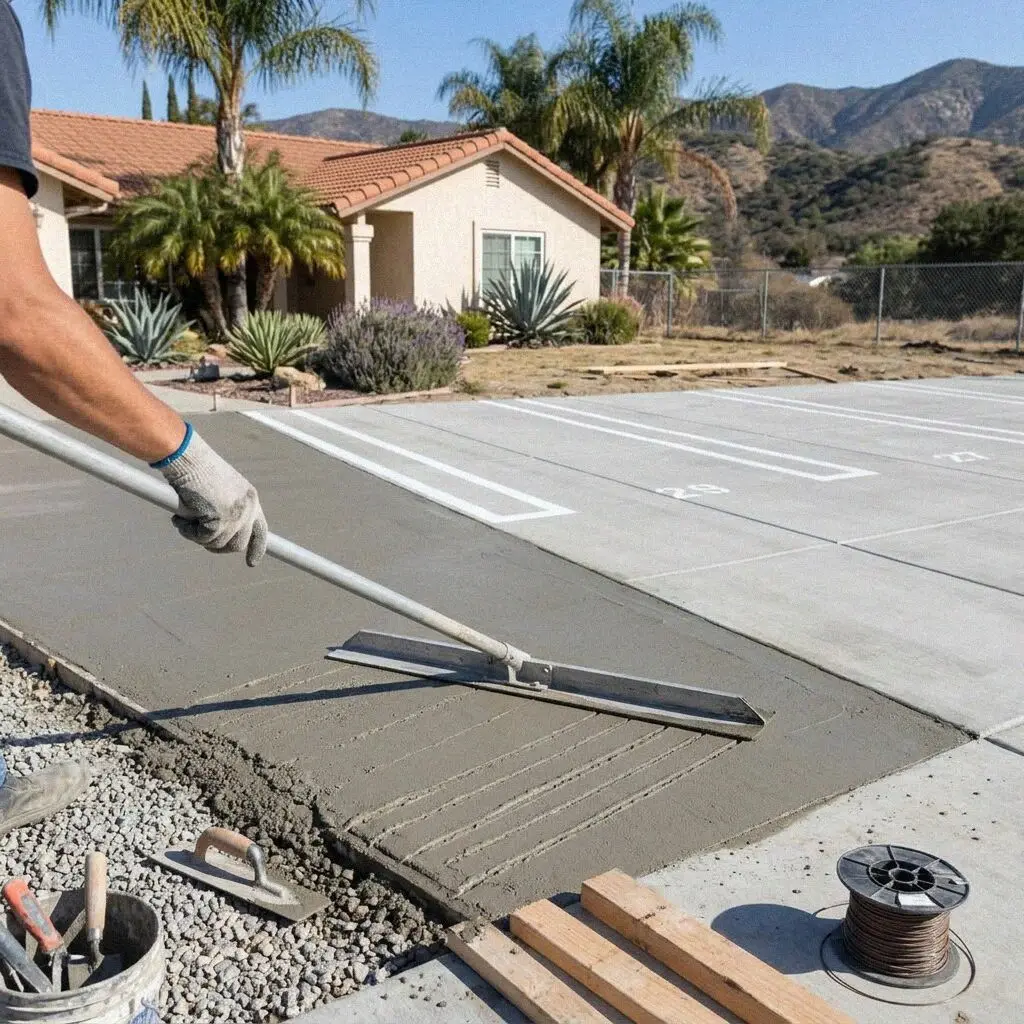
Crew screeding a concrete parking lot pour at an El Monte, CA business
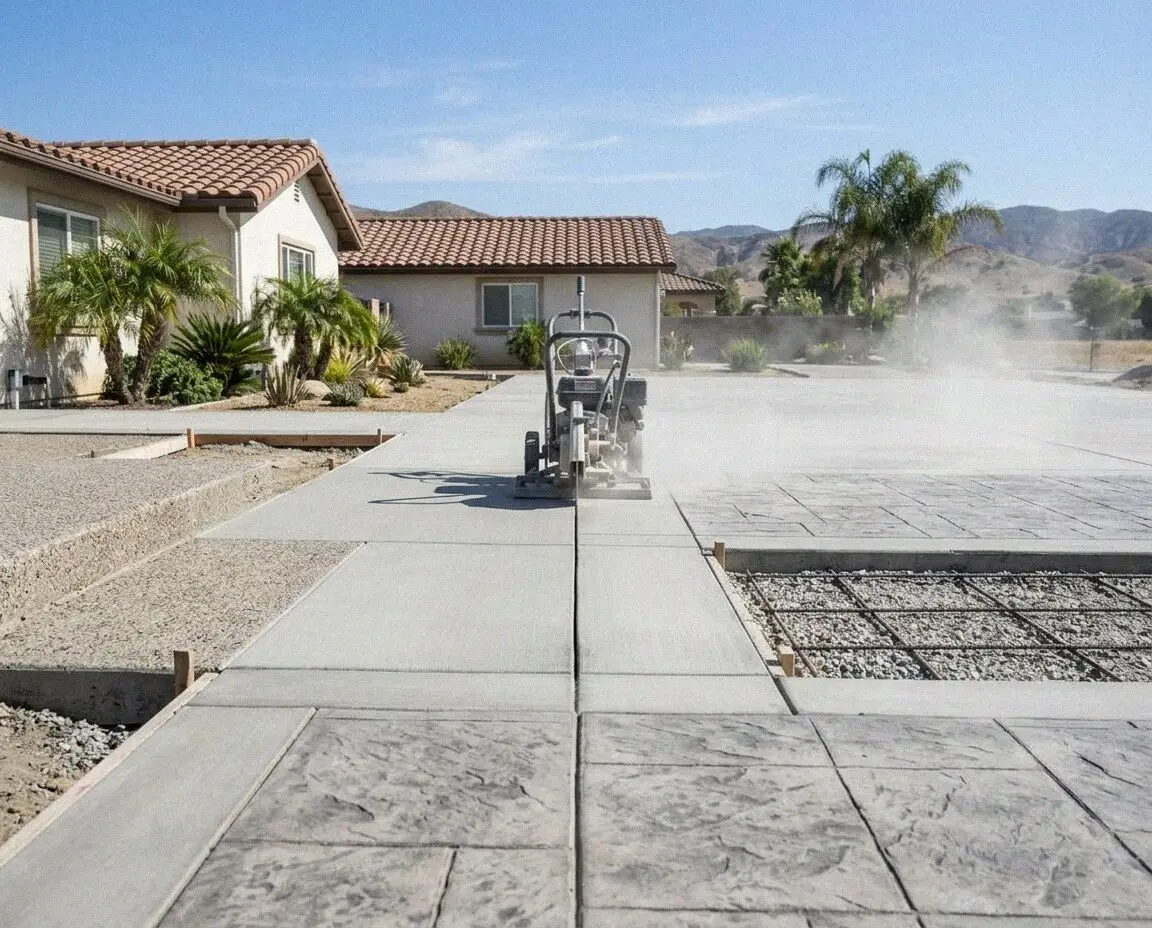
Hands setting a dowel basket across a sawn joint line in an El Monte lot

By what parks on it

How We Build a Parking Lot in El Monte

A parking lot does not wear out evenly. Nine tenths of it holds a parked car that never moves, and one tenth takes the refuse truck, the delivery van and every wheel that enters and leaves. So the lot is drawn as two things before it is poured: stall bays at 5 inches on a plain grid, and a drive aisle, an apron and a dumpster pad at 7 or 8 inches with dowels across every joint. The thin part lasts because nothing heavy crosses it. The thick part lasts because everything heavy does.

Rio Hondo El Monte Concrete has been Ismael Duarte's since 2015, after 21 years on commercial flatwork crews across the San Gabriel Valley, and he lays out every joint grid himself. The lots we rebuild sit behind the shops on Valley Boulevard and Garvey Avenue, under the apartment courts off Santa Anita Avenue, and in the yards along Peck Road where a forklift and a bobtail cross the same slab. Most were asphalt laid in the 1970s and 1980s and patched until the patches met.

Lots are built under a CSLB C-8 license held with the California Contractors State License Board, with liability insurance on every job. A rebuilt lot goes to Building & Safety, and through the Planning Division where a stall count or a driveway moves, and the apron is an encroachment permit from Public Works. Accessible stalls are laid to the California Building Code. Every lot carries a written workmanship guarantee against defects in how it was built.


Repave or rebuild

When is an El Monte parking lot past patching?

Ruts where the refuse truck stops

A front-loader puts its whole weight through two axles while the forks lift the bin, and asphalt under that spot shoves into ridges an inch high inside a summer. Ruts at the enclosure mean the surface is too soft for the one truck that comes weekly, and filling them changes nothing.

The aisle breaking up, stalls fine

When the drive lane has cracked into plates the size of a tray while the stalls either side are whole, the lot is telling you where the load goes. The aisle was laid as deep as the bays and has done ten times the work. Sealing the plates holds a season, then the next set forms.

The apron lifting at the gutter

The apron takes every turning wheel off the street and the gutter beside it runs water along its edge, so it breaks first. A lip where the lot meets the sidewalk is asphalt pulling back from the concrete gutter, and every rain then runs under it. That edge is right-of-way work.

A slab corner rocking under a tire

On an older concrete lot, a corner that dips as a car crosses it and rises after is a panel with nothing under it. Water pumped through the joint has washed the base out from beneath, and the panel is now a lever on the ones beside it. Once one rocks, the joints each side break next.

In the written figure

What Goes Into an El Monte Parking Lot

Eight things are in every lot at no separate line, and each one answers something a lot here has to do: carry a refuse truck on a fixed route, meet a public sidewalk at the apron, and hold its stripes on a surface that a July afternoon takes past 100 degrees.

Old asphalt milled out

The old surface is milled or broken out and hauled the same day, along with the wheel stops, the old stripes and whatever base is underneath.

Subgrade proof-rolled

A loaded truck is driven across the exposed ground and every spot that moves under it is dug out and replaced, before any base goes down.

Base laid and compacted

4 inches of Class 2 base, compacted in lifts and graded to the fall the drainage plan draws, so the slab sits on one firm plane.

Two depths, one pour

Stall bays at 5 inches, the aisle, the apron and the dumpster pad at 7 or 8, on a 3,500 psi mix placed the morning it is batched.

Dowels across the aisle

Every joint in the drive lane and the pad takes a dowel basket, so a truck crossing it loads both panels and neither edge breaks off.

Joints sawn on a grid

Cuts go in inside 12 hours at 12 feet on the 5-inch bays and 15 on the thicker aisle, in panels kept square so no crack chooses its own line.

Accessible stalls flat

The accessible stalls and their aisle are formed flat to 2 percent in every direction and checked with a level before the stripes.

Striped and guaranteed

Stripes, stall numbers, wheel stops and signage go on after the cure, and the written guarantee is handed over on the walk-through.

Ways to build it

El Monte Parking Lot Builds, Compared

Four ways to build or rebuild a lot here, set against what drives on each, the steel across its joints and how soon the stalls are back in use. The base under all four is the same, so the table is about the slab and where it is thick.

OptionBuilt forHow deepAcross jointsStalls open
Two-depth concrete lotShops, courts and small yards5 in bays, 7 in aisleDowel baskets in the aisle only7 days for cars
Heavy yard slabForklifts, bobtails and trailers8 inches throughoutDowels at every joint, rebar mat28 days for the trucks
Concrete aisle in asphaltA large lot on a tight budget7 in aisle, 3 in asphalt baysDowels in the aisle, none in baysAsphalt bays the next day
Pad and apron onlyFixing where the trucks stop8 inches at the pad and apronDowels to the old slab or asphaltRest of the lot never closes

Asphalt costs least to lay and most to keep, and the mixed lot sits between it and full concrete; the doweled 8-inch pad is the one part nobody can add later.

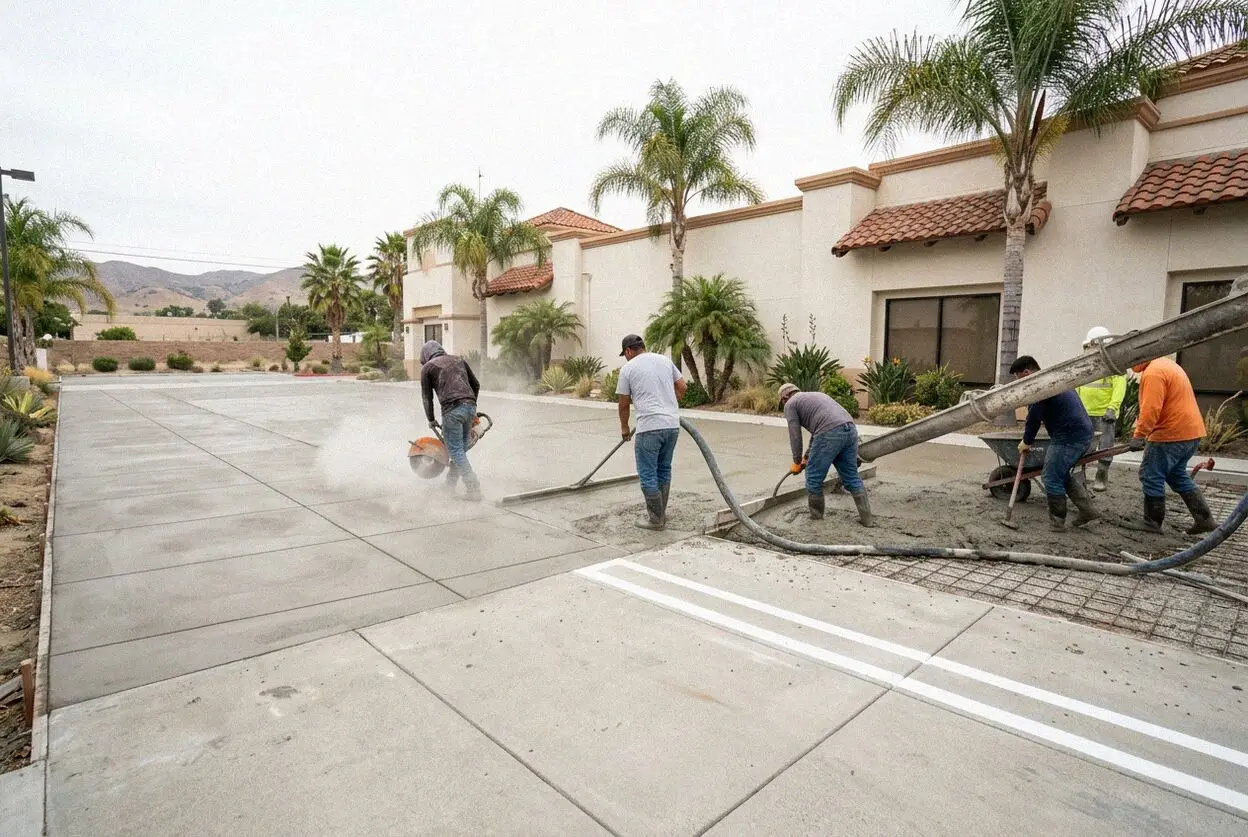
Concrete crew pouring a commercial parking lot beside a building in El Monte

Trucks and ground

Why Lots Wear Out in Lanes Across El Monte

A lot in El Monte is designed around its trucks, which cross it on a fixed line every week, and around ground that drains fast but forgives no slab with a leak under it.

El Monte sits where the San Bernardino Freeway meets the 605, with the Peck Road yards and the Flair Park offices feeding trucks off both, and its commercial lots are working lots. A dealer's transporter unloads on the same forty feet each morning, a bobtail backs to the same dock, and the refuse truck lifts the same bin from the same wheel tracks fifty times a year. A lot laid at one depth is built for the cars and broken by the trucks, so the aisle and the pad are drawn thicker.

The ground comes second. The river sand and gravel under El Monte drains faster than most ground a slab is laid on, so a lot here rarely heaves and never sits in mud. It washes instead. One cracked joint over a soft spot, one broken pipe under the aisle, and the water pumping through carries the fines out from under the panel, which is why the ground is proof-rolled before base goes down and the aisle joints doweled. Where a lot steps down to an alley, a retaining wall goes in.

Mill to stripes

How an El Monte Lot Is Rebuilt With the Doors Open

Five stages, run by one crew in halves so the business stays open, and the person who cored the old lot is the one calling the pour. The apron permit is in hand before the mill arrives, since the street edge cannot be cut on the day.

1

Walk the lot, core the surface

Ismael Duarte walks the lot with you, marks where the trucks stop and turn, cores the old surface for its depth, and writes the figure there.

2

Draw the zones, phase the halves

The plan sets the two depths, the joint grid, the accessible stalls and the fall to the drain, and splits the lot into halves that keep a way in.

3

Mill out, proof-roll, lay base

Half the lot is milled and hauled, the ground under it is proof-rolled, soft spots dug and replaced, and base compacted to the drawn fall.

4

Dowels set, two depths poured

Baskets go in across the aisle joints, forms step the slab between 5 and 8 inches, and the pour starts before 7 AM in summer and is broomed.

5

Saw, cure, swap halves, stripe

Joints are sawn inside 12 hours, the slab is cured seven days while the other half is built, and the stripes and wheel stops go on last.

Behind the figure

What Sets the Estimate on an El Monte Parking Lot

The square footage starts the figure and the share of it that is aisle, apron and pad finishes it. Two lots the same size can be a week apart in work once one has a truck route through it. Every estimate is measured and written on site.

A lot behind a shop

A dozen stalls off the alley, one aisle and one bin. Most of it is 5-inch bay, and the figure moves with the apron and the alley edge.

An apartment court

Tenants' cars in carport bays, one refuse pad, one aisle. The figure moves with the phasing, since every car needs a place to stand for two weeks.

A yard that runs trucks

A dock, a forklift and trailers standing overnight put the whole area at 8 inches on dowels, and the measured truck lanes set the figure.

What the drawing adds

A catch basin and its pipe, bollards at the dock, integral color in the walk bands or a thicker apron the city asks for, each on its own line.

The visit and the written figure cost nothing, the permit fees are named on it as their own lines, and the call to book the visit comes within 1 business day. (626) 774-7973 or send us a message.

Have the truck lanes on your lot measured

Send the form or call, and someone rings back within 1 business day to fix a time. Ismael Duarte walks the lot, marks where the trucks stop, cores the old surface and writes the figure at the property.

Request a Free Estimate

Written on site · No obligation

By submitting, you agree to our disclosure and consent terms, including being contacted by Rio Hondo El Monte Concrete.

Lots we rebuilt

Three El Monte Lots, in Their Owners' Words

Three reviews left on Google, Facebook and the BBB, each about a parking lot and not a driveway or a slab, and each naming the depth poured or the days the business stayed open.

Google review

“We have twenty stalls behind the restaurant and the bin pad had turned to ridges. They rebuilt it in halves so we never lost the entrance, poured the pad and the aisle at 8 inches on dowels and the stalls at 5. The refuse truck has been on it a year and the pad is still flat.”

Kevin T. of El MonteRestaurant lot rebuilt in halves · Google · 2025
Facebook review

“Our yard runs two forklifts and a bobtail across the same strip of asphalt every day and it had gone to rubble. Ismael cored it, found 3 inches over nothing, and poured the lane at 8 inches with baskets at every joint. Twenty-eight days later the trucks were back on it.”

Sam O. off Peck RdTruck lane in a yard · Facebook · 2024
BBB review

“The apron at our lot on Valley had lifted at the gutter and the city would not let us touch it ourselves. They got the encroachment permit, replaced the apron and the first bay at 8 inches and matched it to the sidewalk. Every rain since has run to the gutter instead of under the lot.”

Lupe G. of El MonteApron and entrance bay · BBB · 2026

Before you book

Parking Lot Questions Asked in El Monte

How long the stalls are out of use, what the estimate covers, which permits a rebuilt lot needs, and what is guaranteed once the stripes are on, answered for a working lot in this city.

(626) 774-7973
  • What sets the figure on two lots of the same size?

    The share of the lot that carries trucks. Stall bays at 5 inches are the cheapest concrete on the site and most of it, while the aisle, the apron and the dumpster pad at 7 or 8 inches on dowels are the expensive part and the part that decides how long the lot lasts. After that comes what is under the old surface, since a lot milled down to 3 inches of asphalt over bare sand needs base built up.

  • How long are the stalls out of use while the lot is rebuilt?

    About a fortnight for each half, and the halves are done one after the other so the entrance and part of the stalls are always open. Milling and base take two days, the pour a day, and then the slab cures seven days before a car is on it and 28 before a truck. A twenty-stall lot is finished inside a month. Through July and August the pour starts before 7 AM, because the slab loses water faster after that.

  • Are the stripes and the wheel stops in the estimate?

    Yes, along with the milling, the haul, the base, the dowels, the sawing and the accessible stall signage, all of it on the one written figure. Anything that sits outside it is named at the visit rather than added at the end: a catch basin the drainage plan turns out to need, a water line found under the old aisle, or a fire lane the plan check asks to be widened.

  • Which permits does a rebuilt lot need in El Monte?

    Two, and sometimes a third. A rebuild on private property is a building permit from Building & Safety, and where the stall layout, the count or the driveway changes it goes through the Planning Division on the way. The apron and any curb work belong to the city and take an encroachment permit from Public Works, and a street the city has recently rebuilt cannot be cut at all. Restriping alone needs no permit.

  • Will property insurance cover a lot that has broken up?

    Not one that has worn out, no. A commercial policy treats rutting, cracking and settlement as maintenance rather than a sudden loss, so an asphalt lot patched for twenty years is the owner's to replace. A truck that drove through the enclosure wall, or a water main under the lot that burst and washed the base out, is a covered event and worth a claim. Photograph the lot before it is milled.

  • What is guaranteed on a finished parking lot?

    How it was built: the base depth, the two slab depths, the dowels across the aisle joints, the joint spacing, the fall to the drain and the finish, each printed on the estimate before you sign. The lot carries a written workmanship guarantee against defects in how it was built. Tire marks, oil, stripes worn by use and ground moving beyond what the joints control sit outside it. Where the fault is ours we fix it.

  • What mix and what steel go into the aisle?

    A 3,500 psi ready-mix placed the morning it is batched, with number 4 rebar on a mat through every panel poured at 8 inches and smooth dowel bars in baskets across every aisle joint. The stall bays at 5 inches carry fiber in the mix rather than a mat. Base is Caltrans Class 2 aggregate, compacted in lifts. The mix, the bar and the dowel size are named on the estimate, so the truck's ticket can be checked.

  • Does the business have to close while the lot is poured?

    No. The lot is built in halves, and the half being built is fenced off while the other stays open, so the entrance and a share of the stalls are in use every day. On pour day the crew needs the fenced half empty from 6 AM, water at a tap, and the bin moved to the open half for that week. If the lot has one entrance, it is poured in two pieces on two days so a car can always get in.

Beyond the city line

Concrete Parking Lots Around El Monte

The eight nearest towns to the Peck Road office, closest first. Each one permits its own apron and inspects its own accessible stalls, and every lot is cored and measured at the property before a figure is written.

Show All Areas We Serve

Book a free measure of your El Monte lot

Call or send the form and you hear back within 1 business day. Say roughly how many stalls there are, which trucks come in and how often, and whether the lot can close in halves, and the visit can be booked inside the same week.